
Backpack Safety: Protecting Kids’ Spines This School Year
Watch the pickup line at any Conejo Valley middle school in late August. Half the kids lean forward under their packs like they’re walking into the wind. That lean is the tell. A bag loaded past what a 90-pound seventh grader should carry, slung off one shoulder, hauled across campus ten times a day for nine straight months.
The American Academy of Pediatrics sets the limit at 15% of a child’s body weight, which is 15 pounds for a 100-pound kid. Plenty of loaded school packs sail right past that number by October.
Quick Summary: Key Takeaways
- 15% ceiling: A packed backpack should never top 15% of your child’s body weight, and 10% is the safer target for elementary kids.
- Both straps, every time: Slinging the bag over one shoulder loads one side of the spine and causes most complaints.
- Heaviest item against the back: Textbook or Chromebook flat on the back panel, lunch and water split left and right.
- Four-inch rule: Nothing should hang more than four inches below the waistline or rise above the shoulders.
- Repeat complaints need an exam: Weekly shoulder aches, arm tingling, or headaches that only show up on school days are worth checking.
A Loaded Backpack Changes How a Child Stands
An overloaded pack shows up in posture before it shows up as pain. Kids compensate fast. Look for a forward head lean, shoulders rolled in, and one hip riding higher than the other while your child stands still wearing the bag.
Repetition sets it in. Ten trips a day, five days a week, and the muscles meant to hold a child upright start treating the compensation as normal posture. Backpacks don’t cause scoliosis, and the AAP is clear about that. Strain, neck aches, and sore shoulders are common in grade schoolers and teens.
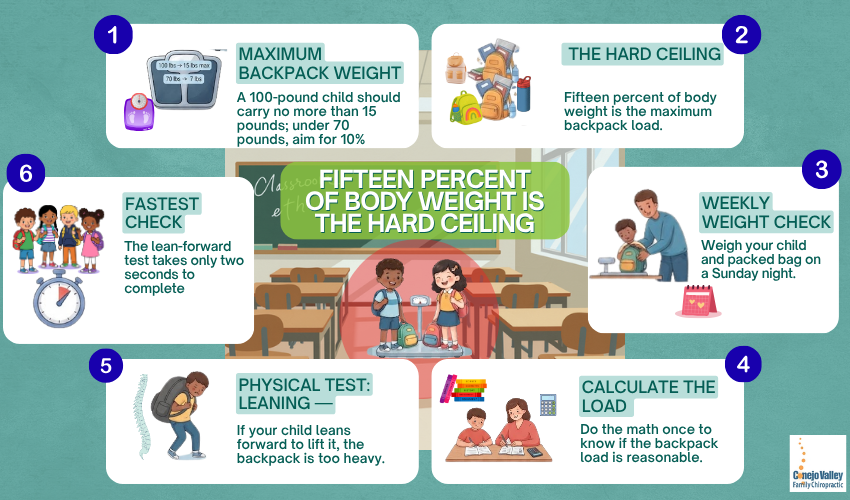
Fifteen Percent of Body Weight Is the Hard Ceiling
Weigh the bag. A 100-pound fifth grader shouldn’t carry more than 15 pounds, and for kids under 70 pounds, 10% is the safer target: roughly 7 pounds, or a laptop, one binder, and a water bottle.
Use the bathroom scale on a Sunday night. Weigh your child, weigh the packed bag, do the math once, and you’ll know for the rest of the semester whether the load is reasonable or ridiculous. If your child has to lean forward to lift the pack off the floor, it’s too heavy. That test takes two seconds.
Fit and Strap Adjustment Do Half the Work
A correctly sized pack worn badly still hurts. Fit beats shopping. Straps should be at least two inches wide and padded, both of them on the shoulders, and the pack should sit flat against the back rather than swinging behind it.
Tighten the straps until the pack rests in the middle of the back, then buckle the waist or chest strap so the weight rides on the hips instead of the shoulders. Four inches below the waistline is the limit at the bottom. Nothing should rise above the shoulders. Bigger bags just get filled.
How the Bag Is Packed Matters as Much as What Goes In It
Heaviest items go closest to the spine. Textbook or Chromebook flat against the back panel, lunch and water split between left and right, small stuff in the outer pockets. One change, and the load moves off the shoulders onto the strongest muscles a kid has.
Then empty it. Dump the whole bag on the kitchen table every Sunday, pull the three-week-old worksheets and the second water bottle, and you’ll usually lose two to four pounds without touching a textbook. Rolling packs are a fair option if the campus allows them, so check with the front office before you spend the money.
Repeat Complaints Are the Signal to Get a Child Examined
Book an exam when the complaint repeats. One sore afternoon means nothing. Same shoulder ache every Tuesday, red grooves across the shoulders after school, headaches that appear on school days and vanish by Saturday: those are patterns worth a closer look.
Numbness, tingling, or weakness in an arm or hand deserves attention that week rather than next month, since nerve symptoms in a growing child are worth ruling out properly. Same for a kid who quietly stops carrying the bag. And no adjustment fixes a 22-pound backpack.
A Kids’ Visit at Our Thousand Oaks Office Starts With an Exam
The exam comes first. Dr. Hans C. Delfo checks posture, spinal motion and how your child actually wears the pack before recommending anything. Bring the backpack. Loaded, exactly the way it gets worn to school.
Conejo Valley Family Chiropractic is a family practice on E Lombard St, treating grade schoolers through grandparents from Thousand Oaks, Newbury Park, Westlake Village, Agoura Hills, Oak Park, and Camarillo. A pediatric visit is gentler and shorter than the adult adjustment most parents remember. Most families leave with two or three specific fixes: strap height, what comes out of the bag, and which shoulder to stop favoring.
Frequently Asked Questions
Q: How much should a school backpack weigh for a child?
A: No more than 15% of the child’s body weight, per the American Academy of Pediatrics, so 15 pounds for a 100-pound kid. For elementary students under 70 pounds, aim closer to 10%. Weigh the packed bag on a bathroom scale once.
Q: Can a heavy backpack cause back pain in kids?
A: Yes. Heavy or badly worn packs are linked to back, neck, and shoulder pain in children and teens. They haven’t been shown to cause scoliosis, but the repeated strain is real, and weight and fit changes cut it down.
Q: What age can a child see a chiropractor in Thousand Oaks?
A: Conejo Valley Family Chiropractic is a family practice and sees patients of all ages, including school-age children. A child’s visit begins with an exam and health history. If something belongs with a pediatrician or specialist, you get that referral.
Q: Are rolling backpacks better for kids’ backs?
A: Usually, if the school allows them. A rolling pack shifts the load to the floor instead of the shoulders, which helps kids hauling heavy textbooks and a laptop. Stairs and crowded hallways are the catch, so check the campus policy before buying one.
Book a Back-to-School Posture Check Before the Load Becomes a Habit
Backpack season starts in August and doesn’t let up until June. Bring your child and the loaded pack, and get weight, fit, and posture looked at in one visit. New patient paperwork can be filled out at home first.
Conejo Valley Family Chiropractic (Dr. Hans C. Delfo) — 268 E Lombard St, Thousand Oaks, CA 91360
Hours: Mon, Wed, Fri 8:30 am-6:00 pm; Tue, Thu 8:30 am-5:00 pm; closed 1:00-3:00 pm daily; Sat-Sun closed
Website: bestthousandoakschiropractor.com