
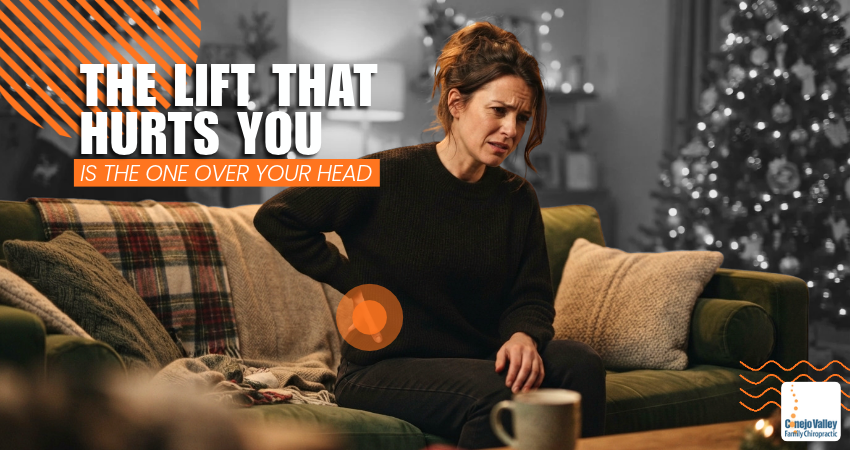
The Lift That Hurts You Is the One Over Your Head
The injury almost never announces itself during the lift. It shows up later the same evening, when you stand up off the couch and something in the low back has locked. By the next morning it hurts to put on socks, and you spend it trying to remember which of the eleven things you did in the garage caused it.
The scale of this is larger than people assume. About 14,900 people were treated in emergency rooms for holiday decorating injuries during the 2023 holiday season, the Consumer Product Safety Commission reported, roughly 160 a day, with nearly half of those involving falls. The strains that never reach an emergency room are not in that number at all.
Quick Summary: Key Takeaways
- Overhead retrieval is the riskiest move of the season: arms extended, load unseen, spine arched backward.
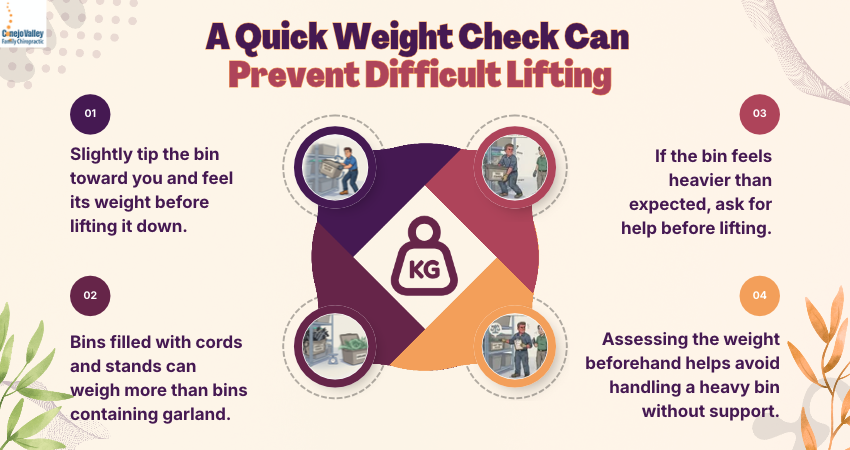
- Weigh the bin before it comes down: cords and stands weigh several times what garland does, and the two boxes look identical from the floor.
- Turn with your feet: rotation under load is where December strains happen.
- Leg pain past the knee gets examined: numbness or a weak foot is a nerve symptom.
- Split the job across two sessions: eleven months of sitting, then four hours on a ladder, is the actual mechanism.
The overhead reach is the move that gets people
Pulling a bin down from a garage shelf or an attic hatch puts the spine in its weakest configuration. Your arms are extended in front of or above you, which multiplies the load through the low back. You are usually leaning backward slightly to counterbalance. And you cannot see what you are grabbing, so the muscles that should be bracing are busy balancing instead.
Add a step stool and the situation gets worse, because now your base is narrow and your attention is on not falling. A modest box of ornaments handled that way asks more of you than a much heavier weight lifted deliberately off the floor.
Test the weight before you commit to it
The single most useful habit here takes two seconds. Before you lift anything down, tip it toward you slightly and feel what it weighs. A bin packed with cords and stands weighs several times what a bin of garland does, and the two look identical from the floor.
If it is heavier than expected, that is the moment to get help or get a ladder, while you still have a choice. Discovering the weight after it is already moving leaves you no options except to absorb it.
Move your feet instead of your waist
A straight lift of a reasonable weight is something most people handle all day. Adding rotation to it is the version that tends to go wrong. It goes wrong when you set the thing down, not when you pick it up.
In practice this means moving your feet. Pick the box up facing it squarely, then turn your whole body to set it down. Planting your feet and swiveling at the waist is the version that puts people on the couch. It is slower, by about a second a lift.
Ladders, gutters and the awkward middle hours
The second half of a decorating session is when the form falls apart. People get tired, they stop moving the ladder and start reaching sideways off it, and they stop bending their knees because their legs are already complaining.
A reasonable way to handle it is to split the work across two days, or at least to put a real break in the middle. Get down off the ladder, walk around the block, and come back to it. Long stretches of overhead work with the neck extended also leave a lot of people with a headache by the end of the day, and headaches and migraines are on the list of what this office treats.
What the first few days usually look like
The National Institute of Arthritis and Musculoskeletal and Skin Diseases states the home advice plainly: avoid bedrest, limit the activities or exercise that cause pain, and gradually increase physical activity as tolerated. The same guidance notes that most people find relief within six weeks. Stay off the movement that did the damage. Then give the area room to settle before you test it again.
Pain that has not changed after a week, pain that wakes you at night, or pain that is getting worse instead of better belongs in an examination.
→ What chiropractic care involves
The symptoms that mean book an appointment now
Back pain that radiates down the leg past the knee, numbness or tingling in the foot, or weakness when you try to lift your toes all belong in an examination instead of a wait-and-see. Leg pain, weakness, numbness and tingling are among the conditions this practice treats, and they get assessed differently from a muscle strain that stays in the back.
A lifting injury in the garage presents the same way one at work does, and it gets examined the same way.
Our Thousand Oaks Office Looks at Exactly This
Conejo Valley Family Chiropractic is at 268 E Lombard St in Thousand Oaks, and more about the practice and Dr. Hans C. Delfo is at bestthousandoakschiropractor.com.